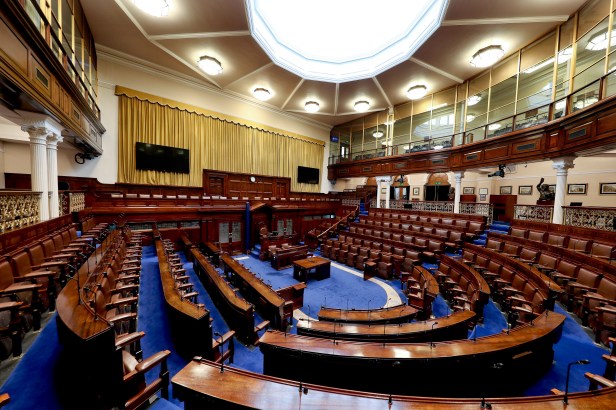
[By House of the Oireachtas – Houses of the Oireachtas’ Flickr account, CC BY 2.0, https://commons.wikimedia.org/w/index.php?curid=126601365%5D
Another protection for unborn babies falls. The three-day waiting period, the part of Ireland’s current abortion laws that was probably saving more lives than any other single provision, is gone. Sinn Féin’s bill to remove it was passed 86-70, with government members having a free vote. The Taoiseach, Tánaiste, and the Minister for Health all voted for it, even as two-thirds of Fine Gael TDs party and almost three quarters of Fianna Fáil ones voted against.
This vote is a grim, tragic thing. Some significant proportion of the 2,000 women per year who went to a first appointment but never came back for a second will have an abortion that they would have reconsidered over three days, and more people will die.
The efforts to protect the three-day wait have been admirable. Irish pro-life organisations and activists have worked hard to get pro-life TDs elected and tirelessly lobbied the TDs already in the Dáil. Their efforts helped stop two previous attempts to deregulate Ireland’s abortion law, and in doing so likely saved thousands of lives. Keeping the three-day wait in place for the few years it was here means that there are human beings alive now who will get to be named, who will get to breathe, who will get to feel the sun, who will get to make things, who will get to fall in love and dream and grieve. No effort spent in that pursuit was wasted.
But I think the passage of the Sinn Féin bill shows once again that this kind of work will never be enough on its own. Leaving aside for the moment the crucial work of direct aid and practical support to pregnant women and their children, we could divide pro-life activism aimed at influencing Ireland’s laws into three broad categories:
* Efforts to increase the influence of people who are already committed pro-lifers
* Efforts to increase the engagement of uncommitted or apathetic pro-lifers
* Efforts to change pro-choice people’s minds so that they become pro-life
Most of what the Irish pro-life movement does belongs in the first category, with less work put into the second and almost nothing put into the third.
It’s easy to see why this is. The Irish pro-life movement is a fundamentally defensive movement. Its function for decades has been to protect the status quo from change. Even the Eighth Amendment itself was an attempt to ward off an incoming threat by constitutionally copper-fastening the consensus. The movement has no real institutional knowledge of how to expand itself. All we know is the attempt to hold a position.
The latest legislative defeat shows that this is like reinforcing a sandcastle against the incoming tide. There are not very many pro-life citizens of Ireland. No matter how good your legislative tactics are, in a democracy if your cause doesn’t have much support you have no leverage. Politicians have very little reason to do what you say unless they believe that significant numbers of people will vote for them if they do.
Even saying this out loud might earn me some disapproval. Part of the game we are playing is creating the illusion that there are more committed pro-lifers than there are: if not a silent majority, at least a silent substantial minority, waiting in the long grass to punish politicians who vote too pro-choice. But as we’ve seen again and again, even among pro-lifers very few actually vote on abortion.
A story illustrates the point. A few years ago my mother, a teacher in a Catholic secondary school, was talking to an elderly religious sister from the order who used to run it. The sister was waxing lyrical about the many virtues of then-Minister for Health, James Reilly. What a charming man he was, from such a lovely family! Wonderful to have a doctor as Minister for Health! At a certain point through the encomium the nun paused, looked a little regretful, and then with a resigned shrug said: “pity about the babies.”
Another thought: when was the last time you heard a politician or a pro-life activist actually giving a reason why they themselves are pro-life? Or a reason why anyone else should become pro-life? We went straight from presuming that everyone agreed with us deep down to presuming that the argument for the human dignity of the unborn was already lost. With apologies to G.K. Chesterton, attempting to change minds on abortion has not been tried and found wanting. It has been found difficult and left untried.
The pro-life movement in Ireland needs to reverse its priority order. The first priority should be changing minds. The second should be getting the nominally or apathetically pro-life to act like the issue is as important as it is. Only then are efforts to maximise the influence of pro-lifers in politics going to stand any long-run chance of bearing fruit.
This is not easy. How to change people’s minds in a pro-life direction in a modern secular democracy at scale is an unsolved problem. But that makes it all the more urgent. Money, time, and planning should all be directed at efforts to figure out how to change minds. We need to try, fail, and try again. We in Minimise are trying to do our part with our conversations workshops, helping Irish pro-lifers learn to talk to pro-choice people in a way that’s actually persuasive. (Get in touch with us if you want to organise one for your group, theminimiseproject at gmail dot com).
But there is so much more that could be done. The Equal Rights Argument is one of the most powerful ways to reach pro-choice people and get them to reconsider their view on the human dignity of the unborn. What if pro-life organisations made it their aim to have every activist in this country able to confidently use it within a year? What can pro-life organisations do to collaborate and make alliances with other social groups that aren’t simply the usual suspects? What if pro-life organisations in this country learned from the Equal Rights Institute’s affiliate programme, and provided university pro-life groups with mentorship and strategic planning? What if the first question the movement asked itself about any proposed initiative was “how will this help change minds at scale?”
We don’t have the answers. But devoting sustained, serious attention to the question itself is crucial. In fact, it’s necessary.
Ben
 The Minimise Project
Something I’ve wondered about on this sort of theme, is how much significant numbers of pro-choicers are seeing abortion opposition, as just a right-wing thing, and thus, just not getting much of a look in from anyone socially progressive (which really hammers the pro-life movement demographically, since the demographics most likely to have abortions are younger, poorer, and aren’t cis men either).
Relatedly, I do anecdotally, feel like in the aftermath of Roe V Wade being repealed, that pro-choicers both got more hostile (for reasons that I feel shouldn’t need spelling out), whereas pro-lifers got a lot more insular and started falling into the trap of not really knowing where to go afterwards- resulting in the conservative parts of the coalition fragmenting into people that do endorse extremist positions (abolitionists who do actually want to dish out life sentances or the death penalty to people who have abortions), and others who aren’t polarising in such an extreme direction, but who instead see it more as one conservative Christian cause among many, with it being put in the same category as things like parents rights or anti-trans views, and often being tied to culture wars around free speech, and non-conservative pro-lifers still being left a bit adrift too.
I must admit I have come to the conclusion that the free speech angle is incredibly counter-productive, it shifts the Overton window from debating “Society must stop killing unborn babies” to debating “Should anti-abortion views be allowed to be heard”, putting us on the back foot, and taking the focus away from caring about the unborn, and into caring about ourselves. It’s also if https://expression.fire.org/p/male-students-show-more-tolerance is accurate in the data it presents, a topic that resonates far more with men than women- which means it’s just going to drive gendered polarisation in a rather counter-productive way, and is probably not super effective at convincing people who aren’t leaning politically conservative either.
Obviously, as we’ve both shared experiences of, censorship of pro-lifers is genuinely real and an actual problem, though it’s an interesting conflict with when universities crack down on disruptive protests against the genocide in Palestine or fossil fuel links- our alma matter did not like it when I handed out leaflets at some departmental open days about the university’s fossil fuel links, we got booted from them.
I am therefore led to a conclusion that may seem quite counterintuitive to many. Pro-lifers should pivot considerably leftwards, or at the least consistent leftist pro-lifers need to self-organise and be outspoken in advocating for strongly left-wing positions like bringing in really agressive rent caps, banning evictions, and the like, and aiming at quite intersectional politics, including making statements in favour of things like disruptive climate protests, BLM, and the like- basically things called “woke”, for lack of a better, and potentially less loaded term. (Yes, this does include on gender and sexuality issues, though I realise this will be hard for a lot of pro-lifers to endorse.) IMO just generally as a movement, we need do as much as we can to break the link in people’s minds between being pro-life and being right-wing, including protests disruptive enough that we’re seen more like mildly annoying climate protesters or well meaning people who go too far in how they advocate for tackling capitalism, as the alternative is being seen as reactionaries with links to the Trump admin or the like. Or alternatively the mvoement would be seen as boring status quo centrists other than on our core issues, and this is very unpopular right now, to put it mildly.
The movement does relatedly need to significantly secularise and deprioritise religion. Truth be told, I at times feel like some pro-lifers at UK March for Life would rather be showy in praying than trying to convince people (and even more bafflingly, the organisers ban graphic abortion images but not the blasted English flag, which is in truth undermining pro-life claims given the UK’s killed millions of unborn babies, and sending out a message that far-right nonsense and Christian nationalism are more welcome than actually protesting society murdering it’s unborn children). I tend to think that if somebody doesn’t care about convincing people (which like, is sadly true of some), they have a case for instead doing targetted non-violent direct action against abortion instead of just, going along with the crowd and treating a protest like a prayer service (there’s plenty of those beforehand for people that want them, but the wider movement is treating non-Christian pro-lifers as second class ones, and I say this as somebody that thinks the resurrection of Jesus straightforward historical fact). Granted I think pro-lifers ought to do more in the way of disruptive protests, as, making abortions happen less by not relying on the law to catch up and ban them+give people much more support with pregnancy and childcare” should be an additional part of the pro-life movement, though I truthfully do not know what this would look like for opposition to IVF.
I do think this strategy is somewhat supported by how effective the equal rights argument is. Such is appealing to the number one value on the left, equality, whereas a lot of the time, pro-lifers make arguments about moral duties to the unborn. These aren’t invalid or necessarily bad ones, but they tend to connect a lot less well with youth and lefties, and good amounts of CLE positions do fit well on the left (and I feel like CLE people are generally significantly to the left of the average pro-lifer); this may be some of why it will at least, get more of a look-in.
(Also, it’s been a while Ben, would be keen to just chit-chat by email, and perhaps try to discuss some of this underlying thinking in more detail, and/or over a phonecall.)
LikeLike