(Source: secularprolife.org)
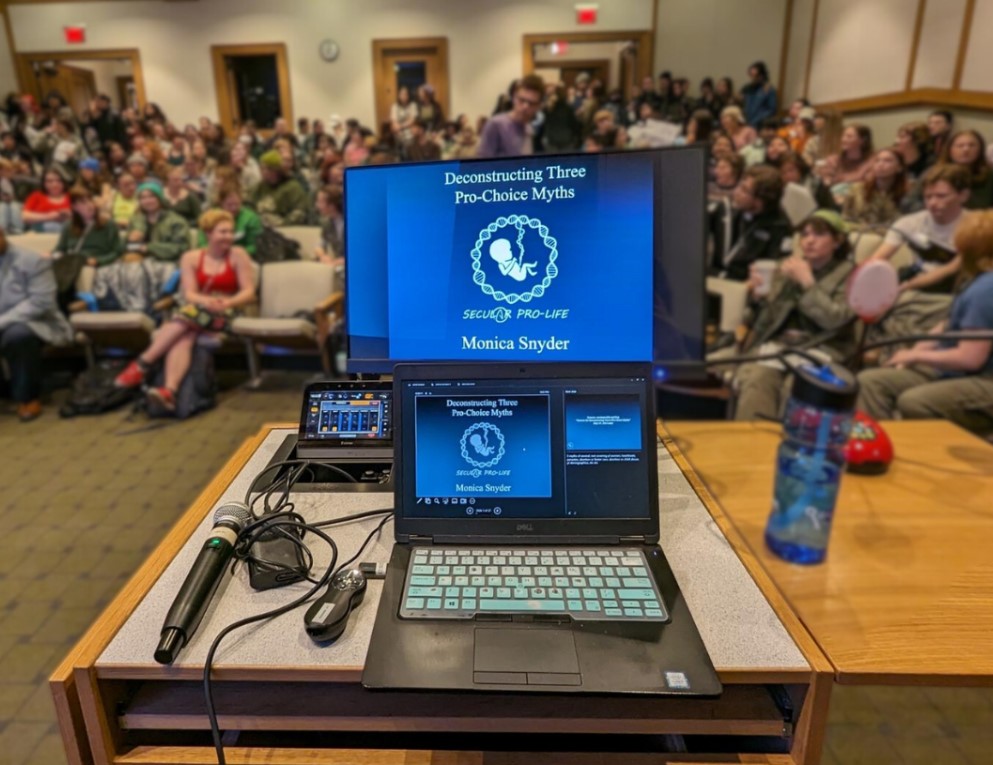
As some sort of unofficial abortion conversation consultant (or whatever I am) one thing that’s extremely heartening is hearing about abortion conversations that have gone well. That’s why I was delighted to read Secular Pro-life’s Monica Snyder’s account of a talk she recently gave at the University of Portland.
While this wasn’t exactly a conversation, it does point to an underappreciated way that conversations about abortion can be helpful and productive: their effect on people not involved in the conversation: people observing or silently listening.
Monica’s talk was a presentation she often gives called “Deconstructing Three Pro-Choice Myths”. Once announced, her talk became controversial on the university campus, with posters for it being taken down and students questioning the administration’s role in promoting it. UP is a Catholic university which allows a pro-life society but not a pro-choice one, and Monica’s talk became a bit of a locus for long-running tensions within the student body, with pro-choice students feeling silenced and unrepresented.
When the time came to give the talk, a majority of the crowd were pro-choice, and many of them were vocally hostile. The talk itself went off mostly without issue, and then the Q&A began. Monica writes:
Nearly all of the questions were from opposing students. There was a lot of cheering for one another’s questions, shouting comments or questions in between each other, jeering at some of my answers or shouting rebuttals or responses to them, and generally just a lot of anger.
The way Monica handled the Q&A was, in my opinion, just brilliant. There are so many things she got right, and I’d recommend looking through her post to see how she handled specific questions. In general she stayed calm, respectful, assumed good faith (more on this below) and responded to each question in detail.
What I want to focus on here though is the response she got after the talk. One student messaged the Secular Pro-Life Instagram account with the following:
I wanted to apologize for the disrespectful behaviour shown by my fellow students tonight. While I personally am pro-choice, I respect that other people have the right to hold beliefs different than mine, and I wish that my peers were able to demonstrate their opinions in a way that fosters a productive educational conversation rather than berating Monica for having different beliefs than them. … [I] would like to thank Monica for giving us her time today and giving us the opportunity to hear from someone whom we may not share beliefs with.
Another pro-choice student said much the same thing. Yet another student, this one pro-life, messaged about taking a pro-choice student friend of theirs to the talk. The pro-choice friend was impressed by a variety of Monica’s points and deeply unimpressed with the heckling. Another pro-life student emailed Monica to say that having previously been uninvolved with the pro-life movement, Monica’s talk had inspired her to join UP’s student pro-life society.
None of these people actually said anything during the event or Q&A itself. This is important! Monica writes:
It’s understandable for all of our focus to go toward the loudest, most vitriolic people, but it’s also a mistake. I believe there were broadly four types of people in the audience that night:
- Pro-life students
- Pro-choice students there to angrily protest
- Pro-choice students there to engage in useful dialogue
- People undecided about their views of abortion
Yes, the second group was frequently disruptive and flippant. For example, near the end of Q&A a student asked how long it had taken me to create my presentation. I said, truthfully, that I update the presentation each time I give it, which doesn’t take too long, but the original from-scratch version took about 50-60 hours to research and put together. The crowd laughed—and that’s useful to me. Because this kind of incivility may bolster the courage of the angry protesters, but it pushes the other three groups away from that tribe.
This is one of the reasons it’s important to remain civil (not obsequious, but calm and sincere) particularly in larger public interactions: our target audience is rarely the person we’re engaging directly, and often the people watching or listening to the exchange. And our demeanor significantly affects how well the silent listeners hear us.
I think this is exactly right, and it applies to more than just big public events like Monica’s talk. Specifically, I think one should think about silent listeners in two particular contexts: public online discussions and in-person group conversations.
Here at Minimise we are generally pretty cautious about trying to have conversations about abortion in online public forums like most social media sites. (Check out ‘A pro-lifer’s guide to social media’.) As an environment it’s a bit of a disaster for productive dialogue. The publicity of it makes it harder for people to change their mind on anything, and the lack of context and ordinary human connection makes it easier for people to relate to each other as just An Opponent rather than as, well, a human being with dignity. Public online conversations can be useful as a starting point, a way of beginning a dialogue that then moves to direct messages, email or (ideally) in-person. But another way they can be useful is that they can help the people silently listening (or, usually, silently reading).
What’s the best way to make them useful in this way? Conveniently, it’s just to conduct your end of the conversation as well as possible. Treating the person you’re talking to with civility and respect, assuming good faith, taking their positions seriously and listening to see what those positions actually are, laying out your own positions with clarity and sincerity: all of these things help a conversation go well, and they’re also likely to leave listeners impressed. Much the same applies when you’re in a group conversation where you’re mostly talking to one person but there are a number of listeners. This works even if the person you’re talking to is behaving badly: in fact, it might work especially well in this situation. There’s very little to be lost by both assuming and expecting the best from people. You can see this in the way Monica saw the people asking her angry questions: “it seemed to me that the majority of the questions were sincere. They were not just posturing, but actually wanted me to respond.”
One of the things I find most encouraging about Monica’s post is that in many ways the situation she described was about as hostile as it’s ever likely to get. It was much more hostile than any one-to-one conversations about abortion I’ve ever had. And yet even here, conducting herself as well as she did bore immediate fruit: some people’s minds opened, others were encouraged to get more involved in pro-life activism. If that isn’t encouraging, I don’t know what is.
Ben
 The Minimise Project