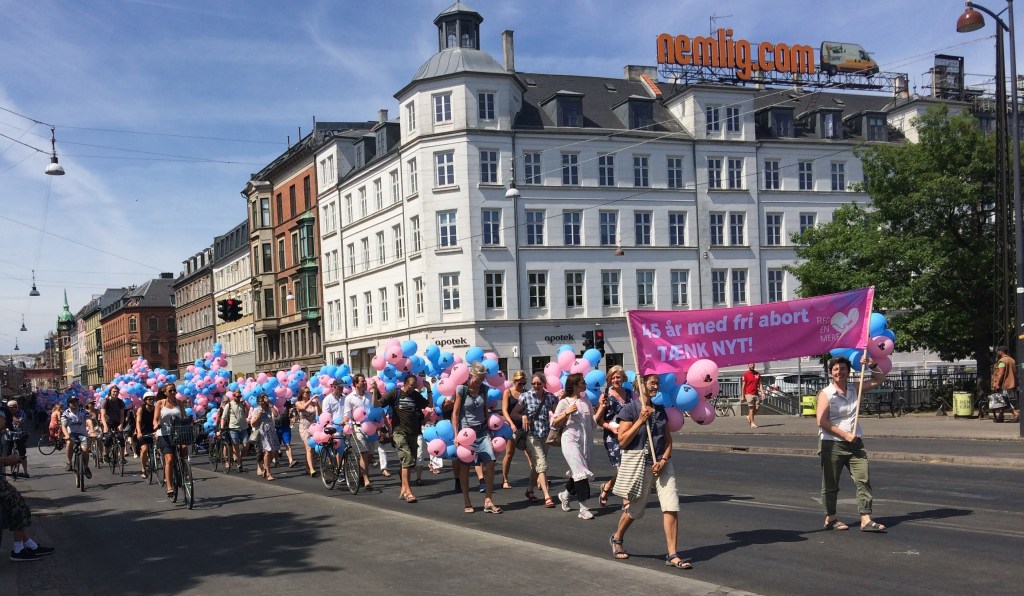
(A march in Copenhagen with 3,000 balloons, representing the number of abortions in Copenhagen annually, part of Right to Life Denmark’s 2018 campaign, Save One More)
We are delighted to present this interview with Kerstin Hoffmann, communication secretary of Danish Right to Life, about the work of the pro-life movement in Denmark and related matters.
Could you tell us a bit about how you got involved in pro-life activism, and about the origins and work of Danish Right to Life?
Denmark is a deeply secular country, and abortion on demand was a natural extension of the counterculture of the 1960s and the fight for free sex and free pornography. These changes initially created a reaction in the Christian/conservative subculture, which left its mark both politically and socially. But it wasn’t until the 1990s that an actual Danish pro-life movement was born.
Danish Right to Life was in the beginning a protest movement. Demonstrations and symbolic happenings put the fight for equal right to life for the unborn back on the agenda again. Personally, I have been pro-life all my life. It was an iconic press photo in a national newspaper, of the chairman of Danish Right to Life, who wiped off his face the remains of a fresh egg that had been thrown at him during a demonstration in Copenhagen, that made me active. The fact that somebody tried to silence people who defended the smallest and most vulnerable persons in our society, became decisive for me.
In the 1990s, the dogmas in the debate were firmly set. An abortion was simply defined as the removal of a lump of cells, and sorrow and remorse after an abortion as fabrications. Danish Right to Life started to push back on these dogmas. And it worked. Photos and ultrasound images of the unborn and personal stories from women who were pressured into abortion or simply regretted afterwards began to appear in the mainstream media. At the same time the number of abortions fell. Nevertheless, support for abortion on demand remained strong in Denmark.
Abortion is today considered an unfortunate necessity. The debate has become much more nuanced. But it has paradoxically left many prolifers in a state of apathy. “How can we allow ourselves to push our position on others who are in an unhappy situation?” is often asked. This has prompted Danish Right to Life to change its strategy. Today our main resources are used on inspiring and equipping the apathic prolifer – especially in the younger generation – with skills to think rationally and argue convincingly. Give them the boldness and beliefs back. Since 2018, we have worked closely with the Equal Rights Institute. ERI’s tools for constructive dialogue are brilliant!
What is the current situation in Denmark as regards the right to life?
After many years of abortion on demand up until the 12th week, a majority in the Parliament has just decided to raise the abortion limit to the 18th week. This is not a response to any demand in the population. This change is more likely a consequence of an ideological strategy – wanting to remove any restrictions on women’s right of self-determination. This movement is unfolding in the WHO (and other UN bodies), the EU, Amnesty, Medicine Sans Frontieres and a lot of other Western institutions. The Danish government wants to take the lead on bodily rights issues both nationally and internationally, and the Danish legislation is of great symbolic value.
The fact that sovereign bodily rights ultimately mean unrestricted access to abortion throughout the pregnancy still creates a strong reluctance in the Danish population. Compassion and a profound sense of responsibility still plays a basic role. But abortion on demand until the 18th week, is a compromise that does not create enough reluctance to apply political pressure. The new legislation comes into force next year.
This expansion of the access to abortion on demand has been a slap in the face to those of us who defend the rights of the unborn. On the one hand, the unborn is the same at week 6, at week 12 and at week 18. Still, it is a defeat every time cynicism defeats compassion in a population that basically wants to do the right thing. That is why we are currently preparing a campaign and an outreach in Copenhagen that will appeal to the public’s compassion with good arguments. (The legislation is still only an agreement – not yet legislation.) We want to turn around the situation and take advantage of the fact that the 18th week abortion exposes the horror of abortion. Everyone can see that it is a little person who is given up on by the legislators.
At the Minimise Project we’re all about having better conversations. Have you any advice in this regard, or any stories from your own experience?
You guys are doing a great job – I love your blogs! Keep up the good work. Endurance is probably what we all need the most. In the public debate about abortion on demand until the 18th week, it has been encouraging for us to see how “our” logic and persuasive arguments for the unborn’s equal right to life is sometimes used by journalists in the mainstream media when they do critical journalism. We haven’t seen that before. Persistently arguing logically and rationally is contagious.
Have you any advice for the Irish pro-life movement? Is there anything the movement here can learn from Denmark?
Ireland has a much stronger Christian tradition than Denmark. Take advantage of it! The unique value of every human being is deeply rooted in Christian culture – it is a strong force. But it must be translated into a language we share with our secular friends if it is to provide a basis for legislation. We in Denmark have been waiting far too long to see that – and large parts of the Christian subculture have given in to the thought of abortion as an “unfortunate necessity”.
Have you any thoughts on the most effective ways of changing people’s minds on abortion?
Changing another person’s attitude towards abortion is a long journey together. We haven’t found any shortcut unfortunately. However, I have observed something important. Danish Right to Life runs a helpline, Abortlinien, which addresses people close to abortion, pregnant woman in distress, pressured or just simply alone. The fact that we have this work often makes a difference in a conversation. Rational arguments about the equality of the fetus cannot stand alone. Genuine concern for the woman in distress often opens a door to the skeptic. Caring for the woman creates confidence that our moral compass is intact. The care for the unborn is more than theory and principle. You don’t have to run a help-line to show that, though 🙂
What do you think society should be doing – in Denmark or more broadly – to support women in crisis pregnancy situations?
In Denmark, we have a pretty strong social “safety net” – working for unwanted pregnancies too. Being pregnant should never be penalized financially or lower your possibilities of getting an education and pursuing your dreams. The Danish legislation pretty much secures that!
My concern for the Danish society is merely the sociological pressure placed on the unexpectedly pregnant woman. The widespread freedom to “get out of” an unexpected pregnancy is linked to strong expectations on motherhood. You are obliged to do well. You could have had an abortion.
Pressure comes from the boyfriend who is not ready for fatherhood, the parents, who find their daughter much too young, and from the pregnant woman herself. But pressure also comes from authorities if you are dependent on public aid or if the expected child is diagnosed with a disability. Bringing a new citizen into the Danish society comes with expectations.
At Danish Right to Life, we want to create a culture where having a child is considered a positive life event which no one must cope with alone. We want to create a culture where every child is welcomed and where women who carry the task of bringing a new citizen into the world receive the community’s respect and recognition.
Find out more at rettentilliv.dk
 The Minimise Project
What party is prolife?
LikeLiked by 1 person